The Wolli Creek Preservation Society has been carrying out bushcare in the Wolli Creek Valley for many years. We currently have 6 active sites, each with its own team that meets regularly, to control weeds and expand the area of protected bush.
Wolli Creek Regional Park stretches for 5 km from Bexley North to Tempe, where the creek meets the Cooks River. The Regional Park is mainly bushland with a wide variety of remnant vegetation and bird life.
If conditions are right, National Parks will be conducting a slow, controlled hazard reduction burn on Nannygoat Hill this Friday April 24th. This much-needed burn will help protect bushland and nearby houses from bushfire, plus help the bush regenerate and dormant native seeds in the soil to germinate. The burn a few years ago at Girrahween was very successful. There will be some smoke and haze, so keep an eye out.
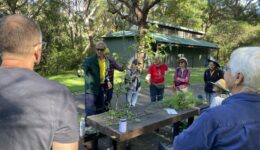
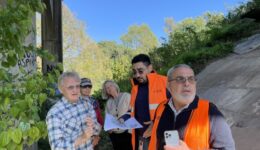
WCPS Bushcare Coordinator Paul Ibbetson recently led an ‘Intro to Bushcare’ session down at the Girrahween Park picnic area for the bushcare-curious. Participants keen to learn were also joined by some of our skilled bushcare team leaders, who came to lend a hand and help teach some skills.
Paul gave participants an introduction to the history of the valley, development, resistance to the M5 motorway and establishment of the TVT walking trail. He also explained how the Wolli Creek Regional Park sits in a narrow valley, which makes it particularly susceptible to ‘edge effect’, where vegetation from nearby residential gardens and streets brings seeds and weeds into the bush. The narrow strip of bushland also provides important continuity of habitat for both plants and animals.
John, who lives in nearby Sutton Ave, regularly runs through the park. “I came because I want to help keep the weeds under control. I grew up in this area and we’ve now moved back. We need to help look after this special place.”
A very important skill in bushcare is the ability to recognise weeds and distinguish them from desirable natives. People were given an introduction to the main weeds in the valley, such South African Veld Grass, Couch Grass, Privet, Ochna, Morning Glory, Balloon Vine and Asparagus Fern.
Participants also learnt to recognise native plants growing in the Girrahween area, like Pratia, Bursaria, Pomelia, Dodonia and the Cheese Tree. Then the team split up into nearby woodland to learn and practise some practical skills in recognising and removing weeds.
Participant Meg said, “I live nearby in Marrickville and wanted to do some volunteering in the area. I found this online – and it’s really interesting! So beautiful down here too.” Fran has already volunteered on some bushcare sessions, “I find it really inspiring to see the difference we can make, especially when we have before and after photos. Makes me want to work even harder to remove the weeds.”
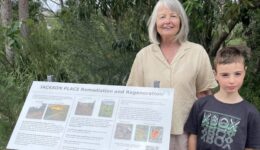
Committee member Julia Frecheville and her grandson Otis show off the new sign she organised about the history of the remediation and regeneration site in Jackson Place. Congratulations for all your efforts Julia. If you’re in the area, pop down and have a look.
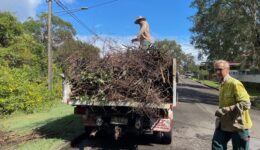
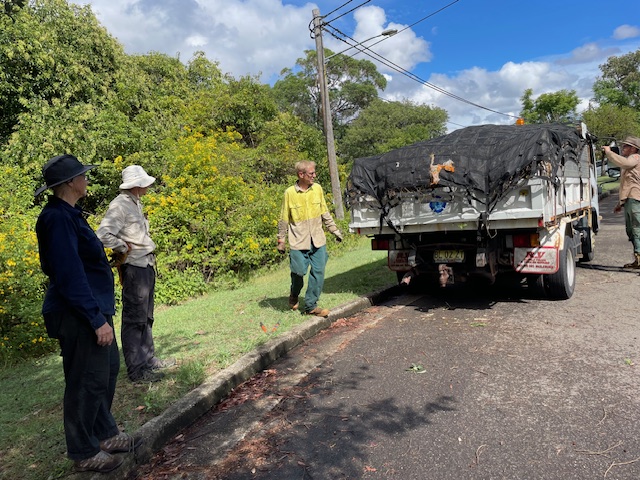
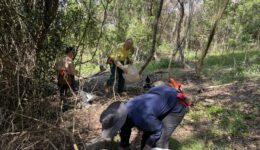
The Johnston Street bushcare team coordinated with National Parks to do a large removal of cuttings from the bushcare site. One of the team Julie Deady, says, “There were several of us, plus the NPWS driver, Rory. We worked from 9 till after 11 dragging cut branches and vines from the bush and piling them on the truck.
Some of the cuttings have been waiting for two years to be removed from the Park, from when they were damaged by Sydney Water. Mainly privet bushes and Ochna (Mickey Mouse Plant) have been removed to allow light through to the forest floor and encourage the growth of indigenous plants. It was a big effort this morning!”
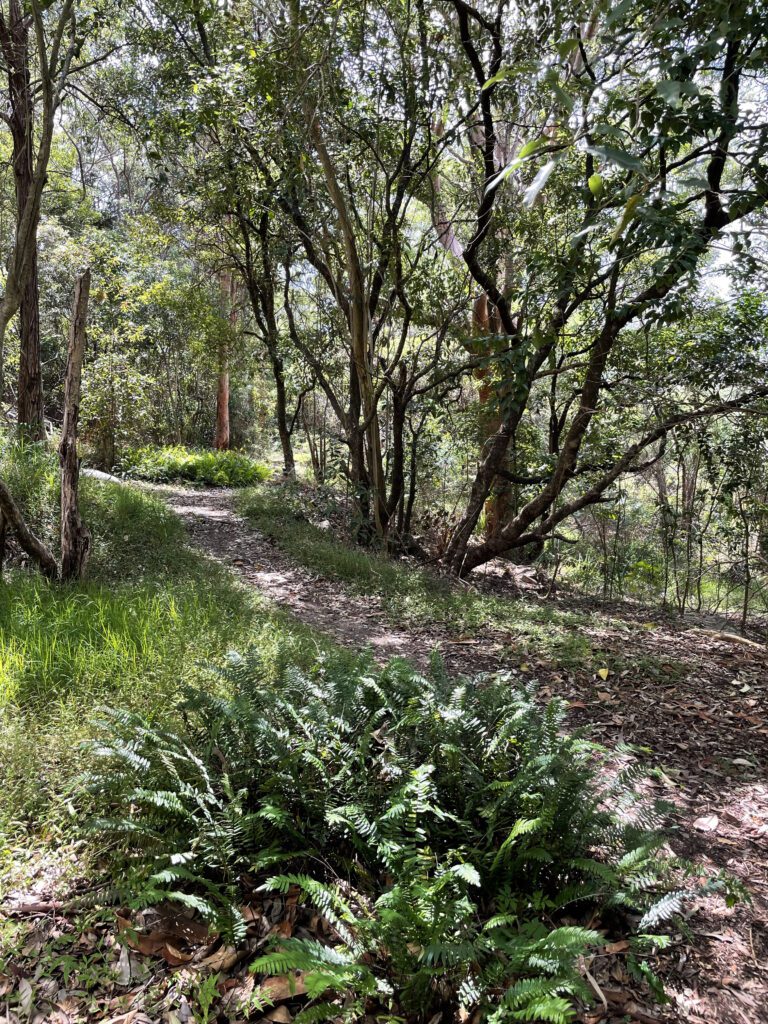
A decade after it was saved from Westconnex, I recently visited the Johnston Street bushcare site and was amazed at how much work the bushcare team has done there. No longer choked by weeds, substantial areas of regenerating bush now look so open and beautiful. Wrens flit through bushes in dappled light and many turns of the track reveal another open view.
The walking track through the western end of the Regional Park leads from Johnston Street through bushland forest to the western park entrance on Bexley Road. This area was the site of one of the very first bushcare grants that the Society received, in the mid 1990s. Careful removal of vines and weeds in places revealed some brilliant bushland underneath and WCPS knew straight away it was worth saving.
Bushcare Coordinator Paul Ibbetson says,
“We have worked hard to open up the dense weedy canopy, vines and asparagus fern to let light in and encourage regeneration. Native plants do better in open, dry, sunny conditions. It’s a lot of work to manage and control the weeds. The bush does not come back by itself. We are very proud of our small team’s results. But we would love some more willing volunteers in our Wednesday morning sessions.”
Contact bushcare@wollicreek.org.au if you are interested in helping the team
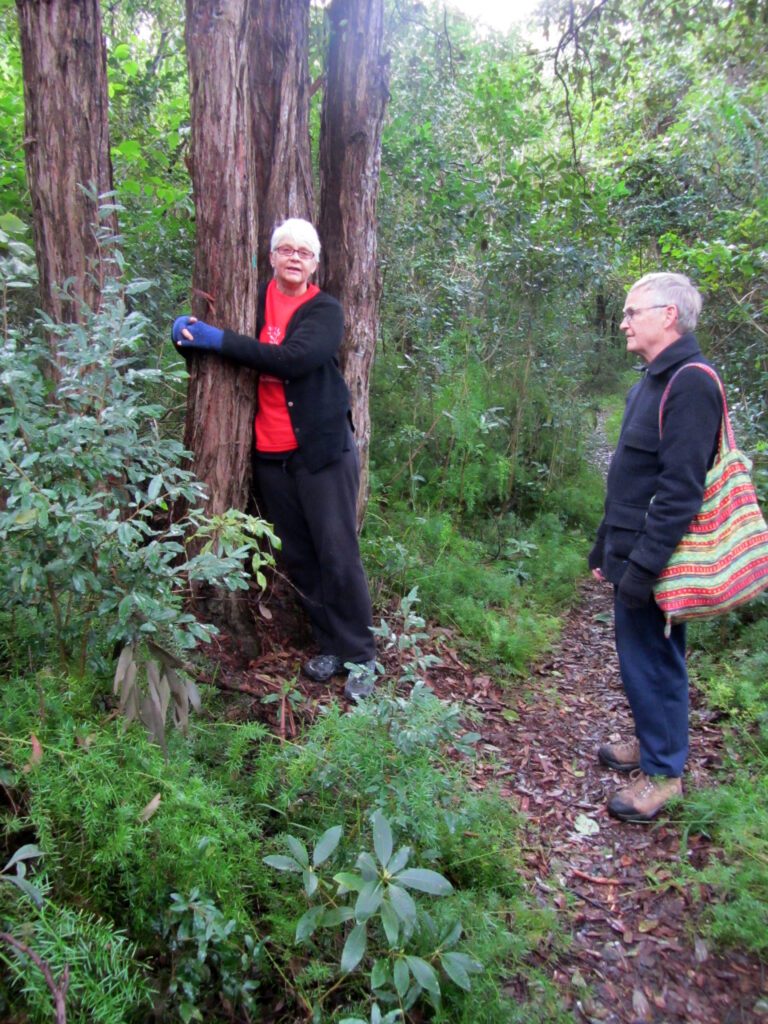
Deb hugs tree 2012
Bushcare team member Deb Little says,
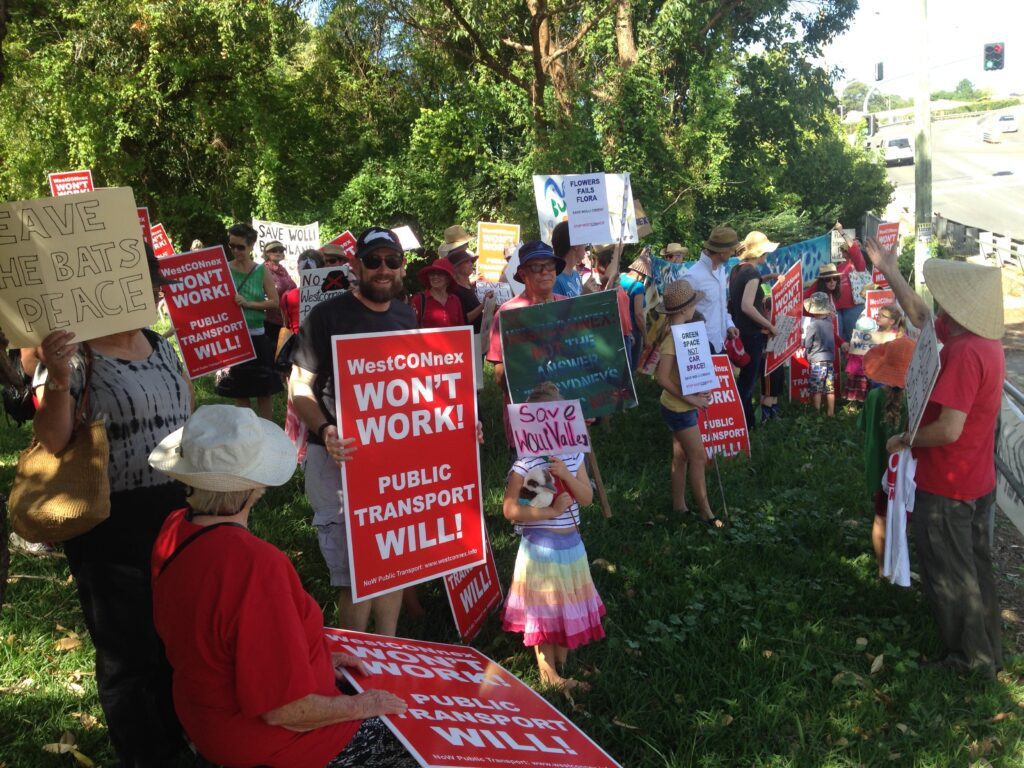
“We’re glad we campaigned so hard to save this bushland from Westconnex in the early 2010s. We were at risk of losing several hectares of native forest to a ‘cut and cover’ motorway tunnel. ”
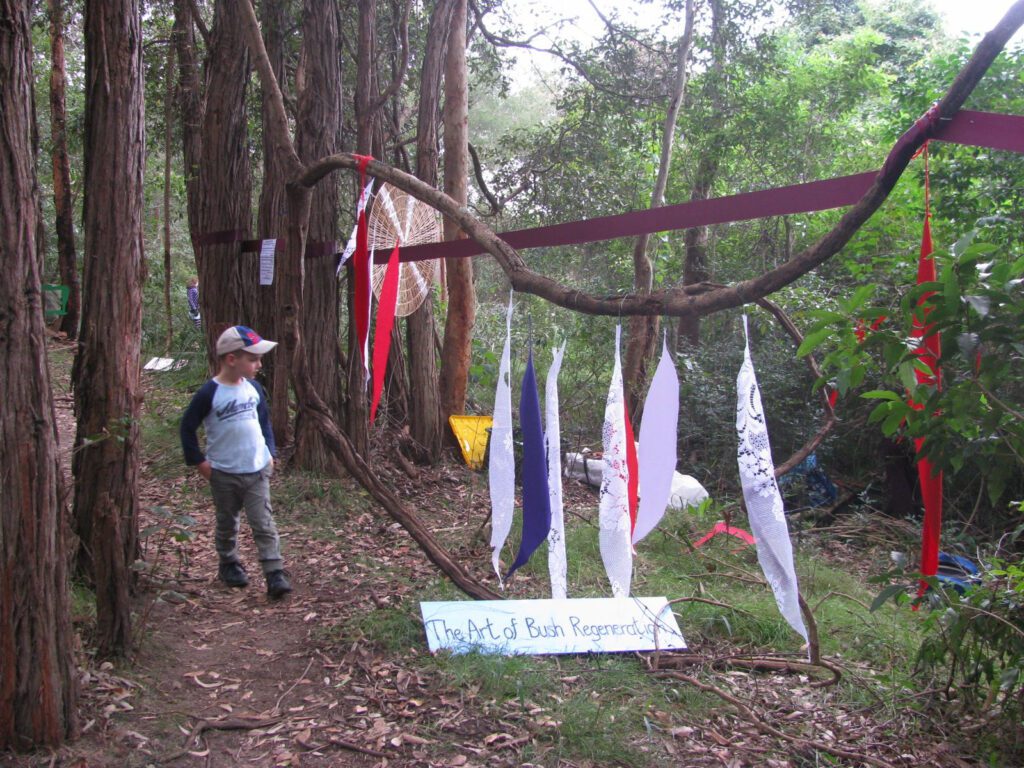
Treemendous 2014Westconnex Protest 2015
As part of the Society’s protests, Deb organised several National Tree Day events to celebrate this bushland and highlight the threat of Westconnex. Many people participated in her ‘Hug a Tree Day’ in 2012, ‘Inspired by Wolli’ in 2013 and ‘Tree-mendous Wolli’ in 2014.
“This area was farmed, you can see remains of stone fences and terracing, so the bush was very disturbed, trashed in fact. It’s remarkable how much it has recovered. We are now seeing nice patches of native ferns and orchids and even the formerly very rare Cabbage Tree Palms are coming back. We’ve seen Eastern Yellow Robins and a Tawny Frogmouth too.”
The Wolli Creek Preservation Society met with engineers from Canterbury Bankstown Council (CBCity) for a site meeting at the Hartill-Law Bridge in Bardwell Park to discuss upcoming rehabilitation of the embankment under the bridge. The eroded embankment is in poor condition and the walking trail there is overgrown with weeds, so we are pleased to see some progress at last.
In 2007, the City of Canterbury, in conjunction with WCPS, received a $10,000 grant from the Cooks River Foreshores Improvement Programme for construction of a board walk under the bridge on the northern side of the creek, which would bypass the only road crossing in the 5 km Wolli Valley walking track. This underpass walkway is the missing link in the Wolli Track section of the Two Valley Trail.
But the planned works weren’t carried out until Canterbury Bankstown Council finally scheduled this work for 2022/23 and planning is now underway.
Council will employ contractors to clear the existing weeds like Crofton, Morning Glory and Lantana choking the embankment. Council engineers will rehabilitate the embankment with shotcrete to stabilize the area and improve drainage on and under the bridge to provide some protection from flooding. Horizontal concrete will also be laid at the bottom of the slope to create the underpass walkway.
WCPS also discussed with the Council Bushcare Officers present at the briefing how the work could be carried out with minimal impact on the nearby bush restoration work, which is carried out by volunteers around and in the wetland to the west of the bridge, off Bray Avenue.
Works are planned to commence in January. If all goes to plan, bushwalkers will have pleasant bush tracks leading to the bridge from both sides and the new underpass as a welcome alternative to crossing busy Hartill-Law Ave.
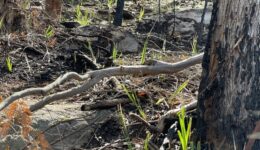
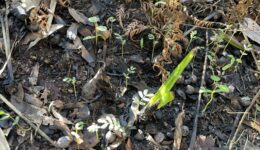
Only a few weeks since the Hazard Reduction burn at Girrahween, it’s pleasing to see how much green regrowth there is to see already. Some plants like ferns and Greenhood Orchids are sending up fresh shoots or leaves, but other plants like these Acacia Kennedias are sprouting from seed that had been laying dormant in the soil until the fire. Everything is getting a good watering with all this rain. Well worth going for a walk to see for yourself.
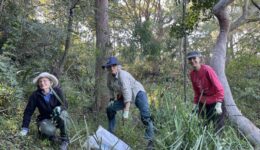
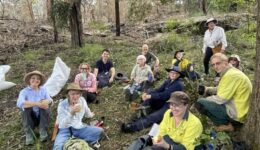
A keen group of bushcarers tackled the weeds at the Hazard Reduction burn site at Girrahween this morning, below Sutton Ave, Earlwood. Bushcare Coordinator Paul Ibbetson is pleased National Parks were able to do the burn in this area, “The bushland is adapted to frequent irregular fires, but since European settlement, fires have been suppressed. These burns help not only protect nearby houses, but they restore the health of the bushland. It’s great to see that after only a couple of weeks, the green shoots of some native plants are already showing.” We saw Kookaburras, Ravens and Currawongs closely inspecting the site for tasty snacks.
The bushcare group made a great start on removing introduced species around the edges of the burn, such as Privet, Ochna, Asparagus Fern and Corky Passion Flower. There will be another session this Wednesday 17th April to continue this important and satisfying work. If you’d like to join in and help us, contact Paul at bushcare@wollicreek.org.au.